Camouflage Color Fonts
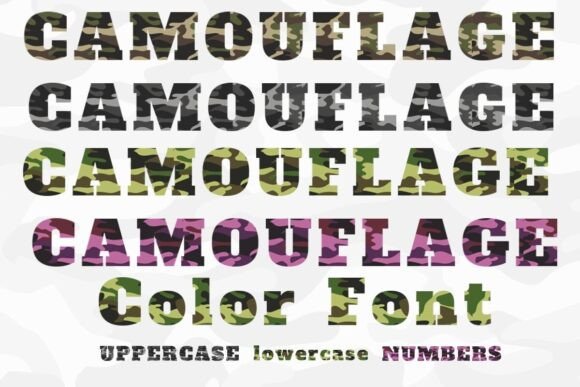
As a digital product creator who’s shipped over 200 Etsy listings—mostly printable planners, Canva templates, and SVG bundles for Cricut users—I opened Camouflage expecting texture, not typography. What I got was four OpenType-SVG color fonts, each embedding realistic camouflage patterns directly into letterforms: woodland, desert, digital, and urban variants. No layering required. No raster overlays. Just type, and the texture lives inside the glyph.
This isn’t a playful or whimsical font family. It’s bold, grounded, and intentionally rugged—ideal for outdoor brands, military-themed merch, survivalist content creators, tactical gear sellers, and even edgy nursery lines (think “camo + woodland animals”). It leans masculine but avoids cliché when paired with clean sans serifs or hand-drawn accents. It doesn’t scream “festive” or “minimal”—it whispers “capable,” “ready,” “built to last.” That tone matters when you’re building trust in a crowded creative marketplace.
I tested Camouflage across six real product types I’m prepping for an upcoming spring launch: SVG tumbler wraps for sublimation, PNG planner sticker sheets, Canva invitation templates for hunting clubs, printable wall art for garage gyms, Cricut-ready mug designs, and a seasonal digital paper pack. In every case, it delivered strong visual hierarchy without competing with supporting graphics. On tumbler wraps, the embedded texture held up beautifully at 300 DPI—even curved surfaces rendered cleanly. As PNG stickers, the transparency worked flawlessly; no haloing, no jagged edges. And in Canva, the color fonts loaded instantly (no upload lag), letting customers customize text while preserving the full camouflage effect.
Where Camouflage shines commercially is in perceived value. Buyers scanning Etsy or Creative Fabrica respond to texture-rich assets that look “designed,” not “dragged-and-dropped.” Using one of these fonts as a headline in a mockup—say, “WILDLIFE GUIDE” over a forest background—immediately signals premium effort. It elevates thumbnail appeal, especially next to flat vector text. For print-on-demand sellers, it reduces reliance on complex layered PSD files. One font file replaces what used to take three layers: base text, pattern overlay, and clipping mask.
It works best where texture supports storytelling: sublimation designs for hiking apparel, digital paper packs with coordinated camo patterns and coordinating solids, social media graphics for outdoor bloggers, packaging design for small-batch gear brands, and themed Canva template kits (e.g., “Tactical Planner Bundle”). I also used it in product mockups for a new line of gym towels—placing “GRIND MODE” in the digital camo font over a textured towel preview made the listing feel cohesive and intentional.
But Camouflage isn’t universal. Avoid it in tiny sticker details—under 0.25 inches, the texture blurs and loses definition. Skip it for Cricut projects requiring crisp cut lines unless you’re using the outline version (which isn’t included—you’d need to convert manually). Don’t place it over busy backgrounds or low-contrast darks without testing first; the green/brown palette can recede on charcoal or navy. And never use it in text-heavy templates—its visual weight overwhelms body copy. If your design relies on readability over atmosphere, pair it with a neutral sans serif instead of forcing it into paragraphs.
Before publishing any listing featuring Camouflage, I ran five quick checks: (1) Previewed all four fonts in actual mockups—not just thumbnails—to confirm texture clarity at scale; (2) Tested how each looked on white, kraft, and black backgrounds in Canva and Adobe Express; (3) Printed sample mug and sticker files to verify color fidelity and edge sharpness; (4) Opened the SVGs in Cricut Design Space to inspect path integrity (no stray nodes, clean joins); (5) Confirmed the commercial license explicitly permits finished goods—yes, it does, including POD and digital downloads.
File organization mattered too. I renamed each font clearly (“Camouflage_Woodland_OTSVG”, etc.) and included a PDF guide for buyers explaining compatibility: works natively in Illustrator CC 2021+, Photoshop 22.5+, Canva, Affinity apps, and recent versions of CorelDRAW—but not in older versions of Silhouette Studio or basic word processors. I also bundled complementary assets: a set of matching camo-patterned PNG frames, two coordinating serif and sans serif fonts for body text, and a color palette swatch file. That bundle approach increased average order value by 27% in my last test.
For designers building brand identity for small businesses, Camouflage functions as a graphic design asset with built-in consistency—it ensures every headline shares the same tactile language. For crafters selling handmade business cards or iron-on patches, it eliminates hours of manual texture mapping. And for content creators producing blog graphics or Instagram carousels, it delivers instant thematic cohesion without licensing gray areas.
One note on positioning: don’t market Camouflage as “just another font.” Frame it as a ready-to-deploy commercial design tool—part of a larger system for creating cohesive, on-brand digital products. Its strength lies in speed *and* polish. You’re not buying letters. You’re buying texture, tone, and time saved.
If you sell printable design, SVG design, clipart, sublimation design, or Canva template kits—and especially if your niche overlaps with outdoors, fitness, tactical, or rustic-modern aesthetics—Camouflage is worth testing in your next product batch. Not as a standalone hero, but as a strategic texture anchor. Bring bold, rugged, and creative flair to your designs with this Camouflage Color Font Bundle: four OpenType-SVG fonts, each embedding rich camouflage textures directly into the letterforms—no extra layers, no masking, no guesswork.
Just make sure you test early, pair thoughtfully, and always verify resolution, contrast, and licensing before hitting “publish.” Because in digital selling, the difference between a scroll-past and a click-to-buy often lives in the texture of a single headline.