Make It Pumpkin
A Whimsical, Warm-Hearted Font That Stitches Like a Dream—If You Know Where to Use It
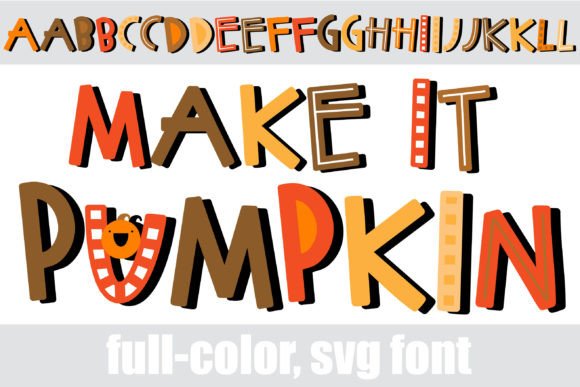
I tested Make It Pumpkin last week while prepping a custom order: a set of linen tea towels for a local kitchen boutique’s Thanksgiving launch. The client wanted something joyful but not cutesy—whimsical, seasonal, and unmistakably handmade. When I opened the file, the first thing that struck me wasn’t just the palette (burnt orange, deep cranberry, warm mustard, creamy ivory), but how the letterforms *breathe*. This isn’t a rigid holiday stencil—it’s a full-color font with personality, built for expression, not just decoration.
First Impressions: Playful, Not Precious
The sans serif base feels friendly and approachable—rounded enough for baby onesies or nursery pillows, structured enough for a boutique apron or embroidered patch on a denim jacket. The “alt case” mentioned in the description? It’s genuinely useful. Switching to those alternate glyphs gave me richer tonal variation without needing to manually recolor each letter—perfect when mocking up multiple product options for an Etsy listing or craft fair display.
But here’s what matters most in embroidery: how does it translate to thread? Unlike many color fonts that assume screen-only use, Make It Pumpkin holds up under stitch simulation. The spacing between letters is generous, the curves are smooth—not overly tight—and the internal counters (like the center of the “a” or “e”) stay open enough to avoid fill-stitch crowding on mid-weight cotton or twill.
Where Make It Pumpkin Shines—and Where It Needs Guardrails
This font belongs on products where warmth and intentionality matter: personalized sweatshirt embroidery for a family Thanksgiving photo, a stitched-on name tag for a baby’s pumpkin-themed burp cloth, or a small-batch run of embroidered tote bags for a local farmers’ market vendor. It reads beautifully at 3–4 inches wide on a tote, and still holds charm at 2 inches on a tea towel hem or pillow cover corner.
It’s also a smart pick for small shop branding—think iron-on patches for staff aprons or subtle chest embroidery on crewneck sweatshirts. Customers respond well to its sincerity; it doesn’t shout “holiday sale!”—it whispers “I made this just for you.” That builds trust, especially for Etsy sellers and handmade shops where perceived effort equals perceived value.
That said, Make It Pumpkin isn’t a one-size-fits-all solution. Avoid using it:
- On highly textured fabrics like bouclé or thick terry cloth—fine details get lost;
- In tiny hoop sizes (under 4” x 4”) without simplifying or resizing—some glyph combinations push density limits;
- On stretchy knits (like lightweight jersey tees) without proper cutaway stabilizer and reduced stitch density;
- For dark fabric backgrounds unless you’ve confirmed thread contrast—those creamy ivories won’t pop on navy or charcoal without testing;
- On curved surfaces like baseball caps unless you’re using a cap frame and have verified letter height stays legible across the front panel.
Real Embroidery Behavior: Clarity, Consistency, Confidence
I ran Make It Pumpkin on three substrates: 100% cotton tea towels (with tear-away stabilizer), midweight fleece sweatshirts (cutaway + topping), and organic cotton baby onesies (lightweight cutaway + water-soluble topping). On all three, the satin-stitched outlines stayed crisp, and the fill areas remained even—not muddy, not sparse. No skipped stitches, no thread breaks—even with the mustard and cranberry transitions.
What surprised me was how well it scaled down for baby embroidery. At 1.75”, the “P” and “K” retained their shape and charm. That’s rare in whimsical fonts, which often collapse into blobs at smaller sizes. For craft business owners selling personalized nursery decor or holiday baby gifts, that scalability is gold.
Practical Designer Notes Before You Stitch
Before committing to a full production run—or uploading to your digital embroidery file shop—do these five things:
- Test on scrap fabric that matches your final substrate, using the same stabilizer and thread colors;
- Check thread color contrast in natural light—not just on screen—especially for light-on-light or dark-on-dark combos;
- Review stitch density in tight corners (like the tail of the “g” or inner curve of the “o”)—adjust if needed for your machine’s tension;
- Confirm hoop size compatibility, particularly if layering with other design assets or working within tight garment zones (e.g., left chest vs. sleeve);
- Verify licensing terms before selling finished products or bundling Make It Pumpkin as part of a commercial embroidery project or digital product pack.
Also: don’t skip the black-and-white mockup test. A design that sings in color can flatten out in monochrome—important if you ever want to offer a simplified version for customers who prefer classic neutrals.
Final Thought: It’s Not Just a Font—It’s a Mood You Can Stitch
Make It Pumpkin works because it understands its role: it’s not trying to be elegant or edgy. It’s cozy, grounded, and quietly confident—like a hand-knit sweater or a handwritten recipe card. That makes it ideal for handmade product creators who want their embroidery to feel intentional, not incidental.
Whether you’re an apparel decorator building a holiday collection, an Etsy seller refreshing seasonal listings, or a hobbyist stitching gifts for loved ones, this font delivers warmth without cliché. It invites connection—not just decoration.
Just remember: every great embroidery file starts with thoughtful prep. Let Make It Pumpkin bring the joy—but let your judgment guide the stitch.