Rainbowberry: A Vibrant Color Fonts Choice for Creative Design
First Impressions: Playful, Juicy, and Instantly Warm
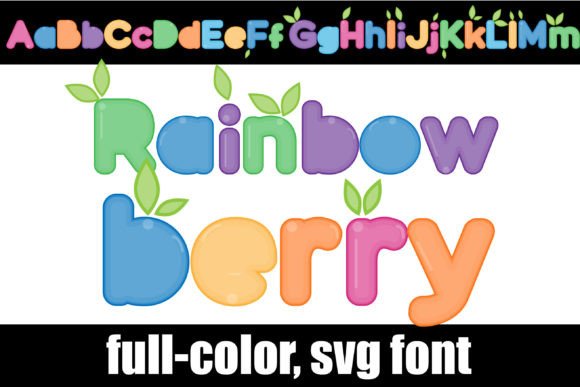
When I opened Rainbowberry for the first time in Illustrator, I felt that familiar designer jolt — the kind you get when a font doesn’t just sit on the page but *breathes* with personality. This isn’t a neutral display font or a subtle script; it’s a full-color font built like a hand-painted berry cluster — soft gradients, organic curves, tiny leaf accents sprouting from ascenders, and a rainbow spectrum that shifts gently across each letterform. It evokes summer farmers’ markets, handmade jam labels, and joyful children’s book covers. The mood is warm, inclusive, and tactile — like something you’d want to hold, not just scroll past. For a client project centered around wellness teas, botanical skincare, or an indie kids’ apparel line, Rainbowberry landed immediately as a strong candidate for hero visuals and packaging accents.
Where Rainbowberry Shines in Real Client Work
Rainbowberry excels where visual emotion matters more than typographic neutrality. In my recent branding concept for a small-batch honey company launching a “Berry Blossom” seasonal line, I used Rainbowberry for the campaign headline on Instagram carousels and printable recipe cards — and it transformed flat mockups into something that felt alive and harvest-fresh. It works exceptionally well in:
- Product mockups — especially on mugs, tote bags, and sticker sheets where its color richness reads beautifully in high-res renders;
- Social media graphics — Pinterest pins and Instagram Stories benefit from its instant readability at medium sizes (24–48pt);
- Cricut projects and sublimation design — the OpenType color layers export cleanly to compatible cutting software when using SVG or layered PNG exports;
- Printable design collections — wall art, greeting cards, and planner stickers gain dimension without needing extra illustration layers;
- Canva templates and digital product bundles — clients love ready-to-use color fonts that skip manual recoloring steps;
- Packaging design details — think jar labels, hang tags, or gift box seals where a single word in Rainbowberry adds artisanal charm.
Where to Use It With Intention — Not Just Enthusiasm
Color Fonts like Rainbowberry are powerful, but they’re not universal tools. I’ve seen them misapplied in ways that weaken brand identity instead of strengthening it. Rainbowberry loses impact — and legibility — below 18pt, especially in dense layouts or on textured backgrounds. It shouldn’t anchor minimalist branding systems, corporate reports, or B2B SaaS websites. Avoid pairing it with other highly decorative fonts; its personality dominates. In logo design, use it only for secondary logotypes or wordmarks where the brand already leans into expressive, handmade business energy — never as a primary logo for law firms, financial advisors, or medical clinics. And while its alt case offers additional color variations via character map, those alternates aren’t always consistent across platforms; test thoroughly in your final output environment before locking in a client deliverable.
How It Shapes Perception — Beyond Aesthetics
Typography shapes trust, tone, and emotional resonance faster than most designers admit. Rainbowberry signals approachability, creativity, and care — qualities that directly support small business branding, Etsy product listings, and print-on-demand launches. When used thoughtfully, it boosts audience engagement by triggering positive sensory associations (fruit, freshness, playfulness). But overuse dilutes its power: applying it to body copy, navigation menus, or legal disclaimers breaks visual hierarchy and undermines professionalism. In editorial design or web design contexts, reserve Rainbowberry for pull quotes, section headers, or campaign banners — never for UI text. Its strength lies in contrast: pair it with a clean sans serif (like Inter or Poppins) for balance, or let it stand alone against ample negative space.
Practical Designer Notes Before You Commit
Before adding Rainbowberry to a commercial design or client asset library, run these checks:
- Test in black and white — does the underlying shape retain character? (It does — the berry contours and leaf motifs hold up well as outlines.)
- Preview on light and dark backgrounds — some rainbow transitions fade on near-white or deep charcoal; adjust background saturation if needed.
- Scale it across real use cases — drop it into a t-shirt mockup at 300dpi, then shrink it to 12pt in a PDF spec sheet — note where detail blurs.
- Verify file formats — ensure your version includes OTF, WOFF2 (for web), and transparent PNG variants if needed for sticker design or digital product bundles.
- Inspect vector editability — Rainbowberry’s OpenType color layers aren’t editable like standard paths, but the base glyph structure remains scalable.
- Compare it contextually — set it beside a classic serif (e.g., Merriweather), a modern sans (e.g., Montserrat), and a handwritten font — notice how it occupies its own emotional lane.
- Confirm commercial license terms — Rainbowberry is licensed for commercial use, including resale in Canva templates, Cricut projects, and print-on-demand assets — but always double-check the vendor’s latest terms before bundling it into a design bundle or SVG design pack.
A Strategic Asset — Not Just a Pretty Font
Rainbowberry isn’t filler. It’s a deliberate creative design decision — one that supports storytelling, strengthens emotional connection, and differentiates a handmade business in crowded digital spaces. When aligned with the right client vision (think: botanical brands, craft fairs, seasonal campaigns, kid-focused products, or wellness communities), it elevates marketing visuals from competent to captivating. As a graphic design asset, it saves time in illustration-heavy workflows and adds polish to digital product launches without requiring custom lettering. Used with discipline — not decoration — Rainbowberry becomes less of a font and more of a brand signature. That’s the mark of a truly useful color fonts investment.