Wild Safari: A Vibrant Color Fonts Choice
First Impressions That Spark Joy — and Caution
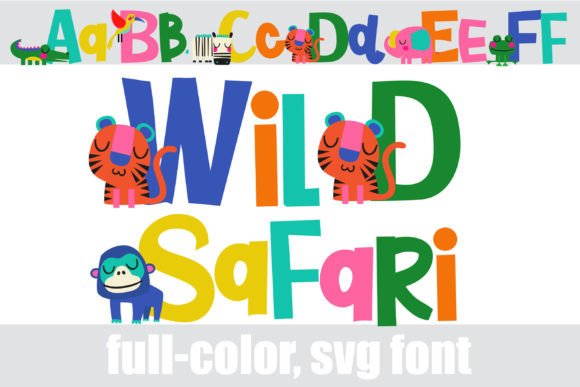
When Wild Safari landed in my design folder for a client’s upcoming summer-themed kids’ activity box line, my first reaction was pure delight — then immediate scrutiny. This full-color font delivers a bold, playful energy: a friendly sans serif base with stylized wild animals embedded in each uppercase letter. It doesn’t whisper — it grins, leaps, and invites interaction. The mood is unmistakably joyful, energetic, and tactile — like a hand-drawn storybook meets modern digital vibrancy. It’s perfect for handmade businesses, Etsy sellers launching seasonal collections, or local zoos and nature centers building family-friendly marketing visuals.
Where Wild Safari Shines in Real Client Projects
In the context of our activity box branding, Wild Safari became the hero treatment for product mockups, Instagram carousel headers, and printable instruction cards. Its strength lies in large-scale, emotionally driven applications: hero graphics on Shopify banners, Cricut-cut vinyl stickers for packaging, t-shirt designs for camp merch, and Canva templates for small business owners running summer workshops. As a graphic design asset, it elevates social media graphics instantly — especially Pinterest pins and Instagram posts targeting parents and educators seeking engaging, screen-ready content.
It performs exceptionally well in packaging design where personality matters: think sticker sheets inside subscription boxes, illustrated tote bags, or mug wraps for eco-conscious crafters. For print-on-demand sellers, Wild Safari adds instant thematic cohesion to themed collections — safari-themed nursery art, birthday party invitations, or educational printable packs. As an SVG design or PNG design, it holds up beautifully across product mockups when layered over textured backgrounds or natural palettes (think kraft paper, sage green, warm sand).
Design Situations That Benefit Most
- Large layout areas — posters, trade show backdrops, wall decals
- Hero graphics — website banners, email headers, digital ad banners
- Product mockups — t-shirts, mugs, stickers, tote bags, notebooks
- Themed campaign visuals — summer launches, zoo partnerships, school enrichment programs
- Printable designs — activity sheets, coloring pages, classroom decor
Where Wild Safari Needs Strategic Restraint
This isn’t a workhorse font for every scenario — and that’s by design. In logo design, I used Wild Safari only as a secondary brand element (e.g., “Safari Summer” subline), not for the primary wordmark. Its visual density competes with clean hierarchy, especially at smaller sizes. On crowded layouts — say, a multi-product Etsy listing banner or a dense editorial spread — it risks overwhelming supporting copy. It also demands careful contrast testing: on light backgrounds, its vibrant colors pop; on dark or complex textures, some animal details fade unless adjusted manually.
Wild Safari should be used carefully in minimalist branding, professional corporate materials, or projects requiring strict visual trust — like medical wellness brands or financial literacy tools. It’s not built for subtle authority. Likewise, avoid it in low-contrast designs or environments where readability trumps charm (e.g., accessibility-focused web design or long-form blog body text). It’s a display font — not a paragraph font — and treating it otherwise dilutes its impact.
What Designers Must Test Before Finalizing
Before locking Wild Safari into any commercial design, I run these checks:
- Test it in black and white — does the animal silhouette retain legibility without color?
- Check contrast on both light and dark backgrounds — especially for social media graphics that auto-resize
- Preview at actual usage sizes — 24pt on a Cricut mat vs. 120pt on a poster yields very different clarity
- Place it on real mockups — not just flat previews, but on physical product renders (mug curves, fabric folds)
- Review print quality — CMYK conversion can mute vibrancy; request a physical proof if using for packaging
- Inspect file formats — confirm OTF/TTF support for your platform, plus whether PNG assets include alpha transparency
- Verify vector editability — if you need to tweak animal shapes or recolor individually, check if SVG layers are separated
- Compare against complementary fonts — pair Wild Safari with a clean sans serif (for body copy) or a gentle script (for accents), never another display-heavy font
- Confirm commercial licensing — this is non-negotiable for client work, Etsy products, or print-on-demand. Ensure redistribution rights cover your use case.
Why Wild Safari Fits the Creative Marketplace — Thoughtfully
As a creative designer sourcing assets for real clients, I value Wild Safari not as a shortcut, but as a strategic tool. It’s not generic clipart disguised as typography — it’s a considered design bundle with intentional personality. When paired with strong brand strategy, it helps handmade businesses stand out in saturated niches like children’s education, nature-based crafts, or boutique event planning. Its alt case with additional colors (accessible via glyph map or Silhouette software) adds flexibility for seasonal updates — swap gold lions for teal monkeys without redesigning entire layouts.
For digital sellers building Canva templates or sublimation designs, Wild Safari offers instant visual cohesion and emotional resonance. For bloggers and content creators, it transforms routine Pinterest pins into scroll-stopping moments. And for crafters using Cricut projects or sticker design, its built-in whimsy reduces the need for layering separate illustrations — saving time without sacrificing polish.
Ultimately, Wild Safari works because it balances fun with function — but only when matched to the right project. It won’t solve weak branding, but it will amplify thoughtful creative design. Used intentionally, it becomes more than a font: it’s a tiny, colorful ambassador for joy, curiosity, and connection — exactly what many small business branding efforts need most.